
To enable Indian banks and financial institutions to develop an aircraft-leasing ecosystem at GIFT City, the Ministry of Civil Aviation has sought support from the Ministry of Finance. It has also raised concern over slow progress in developing aircraft leasing in India.
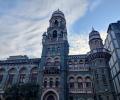
'They wanted the city to be a great business hub. They didn't like the fact that taxes collected in Bombay would go outside the city.'
State-owned Engineers India and MECON as well as four private entities are in the fray for the project to comprehensively revamp RBI's currency management infrastructure in order to cater to future cash needs of the country's fast growing economy. The four private entities are: Accenture Solutions; Colliers International (India) Property Services; PricewaterhouseCoopers and The Boston Consulting Group (India).

Among Sensex firms, Power Grid and Tata Steel fell more than 2 per cent. HDFC Bank, State Bank of India, IndusInd Bank, Hindustan Unilever and NTPC were among the major laggards. Nestle, Bajaj Finserv and Bajaj Finance were among the gainers.

The CBI has significantly increased the rate of fugitive repatriation, bringing back 134 individuals in the last five years, doubling the number from the previous decade. This success is attributed to enhanced diplomatic efforts, technological advancements, and improved coordination with Interpol.

Reaffirming India's stand against terrorism, Prime Minister Narendra Modi has urged leaders of the G7 to galvanise global action against terrorism and underscored the need for strict action against those who 'promote and support' it.

Dalal Street investors were a poorer lot on Monday as their wealth eroded sharply by Rs 14 lakh crore following a sharp decline in benchmark indices amid a global market meltdown due to recession fears. The 30-share BSE Sensex tumbled 2,226.79 points or 2.95 per cent to settle at 73,137.90. Intra-day, the benchmark slumped 3,939.68 points or 5.22 per cent to 71,425.01.
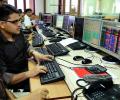
M&M was the biggest gainer in the Sensex chart, rising 6.51 per cent, followed by NTPC, PowerGrid, SBI, HDFC Bank, Asian Paints and Wipro. In contrast, Axis Bank, ITC, HUL, Nestle India and Sun Pharma were among the laggards.

'We were the best team in Asia at one point. Today, we are barely in the reckoning for the Davis Cup.' 'Players now, especially this decade, lack perseverance.'

'In multi-pilot operations, no critical switch can be moved without the other pilot's consent.'
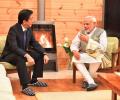
During Abe's tenure, Japan had announced support for a number of major projects. These included the bullet train project between Mumbai and Ahmedabad, besides allocations for a freight corridor between Mumbai and New Delhi.

India is among the three least-favoured Asian stock markets, according to BofA Securities whose survey found that 10 per cent of fund managers are underweight on Indian equities from a 12-month perspective.

From the Sensex pack, Bharti Airtel, Titan, Tata Consultancy Services, Hindustan Unilever, Infosys, Nestle, Reliance Industries, Mahindra & Mahindra, HDFC Bank and Tata Motors were the biggest gainers. However, IndusInd Bank, Bajaj Finance and UltraTech Cement were the laggards.

Investors should tilt their portfolios towards domestic-facing defensive sectors, which should help provide stability and shield them from geopolitical and tariff risks.
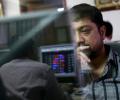
From the 30-share blue-chip pack, Mahindra & Mahindra, Zomato, Tata Motors, IndusInd Bank, Reliance Industries, Larsen & Toubro, UltraTech Cement, HDFC Bank, Adani Ports and Bajaj Finserv were among the major laggards. On the other hand, Hindustan Unilever, Tech Mahindra, Nestle, Bharti Airtel and ICICI Bank were among the gainers.

IFC, a member of the World Bank Group, is helping one of Japan's leading banks, Mizuho Corporate Bank, finance a project that would operate power transmission links between East, North-East and electricity-starved North India.

Beginning in 1990, Japan suffered a collapse in real estate and stock market prices that pushed major banks into insolvency
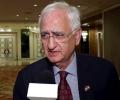
Congress leader Salman Khurshid, who is a part of India's diplomatic mission abroad, on Monday said it is 'distressing' that people back home are calculating political allegiances and asked if it is 'so difficult to be patriotic'.

Both of them are banking on "conducive" conditions to ensure a strong performance.

Among the Sensex firms, IndusInd Bank was the biggest loser and fell 6.13 per cent, followed by SBI (3.99 pc), Hindustan Unilever (3.82 pc), Axis Bank (3.41 pc) and HDFC Bank (3.23 pc). In contrast, Sun Pharma, Bharti Airtel, ICICI Bank and PowerGrid defied the trend and closed with gains of up to 3.67 per cent. TCS and Bajaj Finserve were the other gainers.

India ranks 6th in the Asia-Pacific region for the Italian super luxury carmaker.

Images from the FIFA World Cup Group E match between Japan and Costa Rica on Sunday.
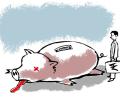
If a bank shuts down, every account holder it has will get back their money for a maximum limit of Rs 5 lakh. It was Rs 1 lakh before.

Shigeru Ishiba is expected to prioritise strengthening Japan's military capabilities and fostering deeper international partnerships, particularly with India, with whom Japan shares significant strategic interests, explains Dr Rajaram Panda.
Japan Bank for International Cooperation has approved a loan of 7331 million yen for the development of Ajanta Ellora Phase II.

Christopher Wood, global head of equity strategy at Jefferies has rejigged his equity portfolios. In his Asia ex-Japan long-only portfolio, he has added Axis Bank (5 per cent weightage) and increased holding in Larsen & Toubro (L&T) by one percentage point. This, Wood said, will be paid for by removing the investment in ICICI Lombard General Insurance and reducing the investments in HDFC Bank and Reliance Industries (RIL) by one percentage point each.
Among the Sensex firms, Power Grid, UltraTech Cement, Titan, Reliance Industries, Bajaj Finance, Mahindra & Mahindra, ICICI Bank, Tata Consultancy Services, Tech Mahindra, ITC and HDFC Bank were the major laggards. HCL Technologies, IndusInd Bank, Wipro, Nestle, Maruti, Larsen & Toubro and Asian Paints were among the gainers.
The Bank of Japan on Friday hiked interest rates from virtually zero (0.069 per cent) to 0.25 per cent.

All sectoral indices ended lower. BSE Telecommunication tanked 2.18 per cent, metal (1.77 per cent), auto (1.70 per cent), energy (1.64 per cent), oil & gas (1.59 per cent), commodities (1.39 per cent) and financial services (1.37 per cent) were the major laggards.

The US Trade Representative noted that India's average applied tariff rate stood at 17% per cent, the highest of any major world economy.

Japan's Sumitomo Mitsui Banking Corporation on Wednesday announced that it would invest Rs 1,366 crore (Rs 13.66 billion) for a 4.5 per cent stake in private sector lender Kotak Mahindra Bank.

Gold prices slumped for the second straight session by Rs 1,150 to Rs 78,350 per 10 grams in the national capital on Monday on frantic selling by stockists and retailers, the All India Sarafa Association said. The precious metal of 99.9 per cent purity closed at Rs 79,500 per 10 grams on Friday.

'I remember our priests saying that he liked sea food. So, they cooked sea food for him without masala and spice.' 'It seems he enjoyed Kerala food very much.'

From the 30-share blue-chip pack, Zomato cracked nearly 7 per cent. Power Grid, Adani Ports, Tata Steel, NTPC, Tata Motors, Tech Mahindra, Mahindra & Mahindra, Asian Paints, Sun Pharma and UltraTech Cement were the other major laggards. In contrast, Axis Bank, Hindustan Unilever, Tata Consultancy Services and IndusInd Bank were the gainers.

'When Prime Minister Modi met President Trump, they agreed to initiate a bilateral trade dialogue.' 'It makes sense to give these negotiations a chance.'

The Japanese central bank on Monday unveiled new measures, entailing short-term loans worth 10 trillion yen (about $ 118 billion) to domestic financial entities, to boost sagging economic recovery.
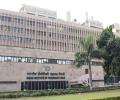
Major recruiters, with double-digit offers at IIT campuses this year so far, include American Express, Barclays, BCG, Cars24, Deutsche Bank, Goldman Sachs, Google, Intel India, Meesho, Micron Technology, Microsoft, OLA, Oracle, Reliance, and Qualcomm.

There is a reason this 11 year phenomenon is a rule as much as it is an observation. It speaks to the nature of man and what humans are like, explains Aakar Patel.

Benchmark equity indices Sensex and Nifty ticked higher for the ninth straight session on Thursday, buoyed by fag-end buying in banking, financial and realty stocks amid encouraging domestic retail inflation data. Weak trends in IT counters and fall in the overnight US equity markets triggered by fresh concerns over recession, however, put a check on market's uptrend. In a largely subdued session, the 30-share BSE Sensex went up marginally by 38.23 points or 0.06 per cent to settle at 60,431.
